Tuesday

Cupofpea.com

www.cupofpea.com
'Banana bag man'

We were shown the blog 'cupofpea' at the beginning of term. The blog has been created by a photographer called Rasmus Vasli. The blog has been created to share his portrait photographs in which he specialises in. "Cup of Pea is about walking the streets and stumble upon people that I somehow find interesting or inspiring, take their portrait, and tell a little story from my meeting with them". (cupofpea.com). I have been following the blog since we were shown it. I am very much interested in portrait photography and consider it to be one my strong point in photography. So i take great delight in looking through recent portrait photographs of strangers in various countries with different backgrounds. Rasmus always puts a little paragraph underneath each photograph to outline why he took it and who the person is. This creates almost like a story of his travels if you read through all of them. You get a great sense of adventure and travelling when you look at the pictures. Besides my love for the blog and what it offers to young photographers, his work is captivating and never dull to look at. You are confronted with people from different cultures and backgrounds and the portraits are diverse. You get a narrative from every image, when you can analyse the picture from the description you are given. Overall, I will proceed to follow this blog and take inspiration from Rasmus Vasli's work.

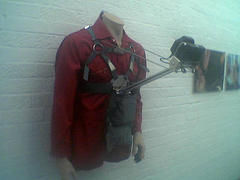
Brendan Walker, The Thrill-Sensing Auto-Portrait Machine.

5416668_9dbd489d2c_m.jpg
Brendan Walkers Autoportrait Machine, 2005
Image taken from: http://we-make-money-not-art.com
My friend recently lent me one of her photography books to have a read through in my spare time. The book is called 'Photography' by John Ingledew. It is a basic introduction book for students and contains facts about photography and also photographers work. On page 148 I came across an interesting photographer called Brendan Walker. His pictures were immediatly interesting to look at, and the description of the work even more interesting. Walker designed a camera that is controlled by human emotion. During a fairground ride the shutter is fire at the thrill peak. The pictures are very aesthetically pleasing as well as interesting to look at. There are light trails which portray movement in the images and the subjects faces show a range of different emotions. His work is innovative and unique and it is really refreshing to see new techniques and the outcome of those techniques. Very inspiring...

Instagram, does it de-value photography?

Instagram - Fast, beautiful photo sharing for your iPhone
Picture taken from: http://instagr.am/
A few weeks back there was  a discussion on line regarding Instagram and whether the new application de-values photography. This is the description the application uses to describe its uses: 'It’s a fast, beautiful and fun way to share your photos with friends and family. Snap a picture, choose a filter to transform its look and feel, then post to Instagram. Share to Facebook, Twitter, and Tumblr too – it's as easy as pie. It's photo sharing, reinvented' (http://instagr.am/). I personally don't use Instagram, so I'm not sure that i can comment fairly on this topic seeing as I haven't trialed and tested the App. However, many friends of mine use it and love using it too. I think the only negative with applications like this is that there is a worry that Analogue will die out. In the debate someone raised an important issue, if, unlike us photography students (who have a good knowledge and understanding of the difference between analogue and digital) you don't have the understanding, then will people who don't have the same knowledge think that this App is an example of good photography? I take this point on board, and in some respects agree with it, however, it is possible to gain an understanding for analogue photography if willing to do so and the App could be a starting point?...

My visit to Yayoi Kusama's exhibition. Tate Mordern.

Yayoi Kusama 'The Passing Winter'
Image taken from: roslynoxley9.com.au

I was fortunate enough to be able to go and see Yayoi Kusama's exhibition at the Tate Modern last weekend. After having read about her work on the Tate Channel and having done some research on her, I was really keen to actually see her work in person. The exhibition is a series of “immersive environments” designed to take us through the phases of Kusama’s career. Her dot designs are seen on balloons in the foyer, but not in the exhibition itself, and a recent installation of a darkened sitting-room covered in fluorescent dots feels like a rather tame reprise of something that would have had more bite in the Sixties. The final room of the exhibition was one of her light installations, the mirrored coloured lightbulbs  made for a magical viewing. Kusama's work evidents her physcological struggle.

Saturday

Damien Hirst at Tate Modern.


Damien Hirst is showcasing his work in the Tate Modern from this week until september this year. This is an exciting and memorable time it's Hirst's first major exhibition in the UK. His work is totally outrageous to look at in pictures, let alone be there and witness the art work first-hand.

Damien Hirst

Tate Modern: Exhibition
4 April – 9 September 2012
£14, concessions available
Open late Friday – Sunday until 22.00


Damien Hirst first came to public attention in London in 1988 when he conceived and curated Freeze, an exhibition in a disused warehouse which showed his work and that of his friends and fellow students at Goldsmiths College. In the nearly quarter of a century since that pivotal show, Hirst has become one of the most influential artists of his generation.


Friday

A Self-portrait series.

Following on looking at some of my personal work, I stumbled across some photographs I took about a year ago. At the time, there wasn't any brief for this particular series, I was just interested in looking at self-portraiture and how I choose to represent myself. I wasn't keen on the photographs when i took them, which probably explains why I've not gone back to them since. But I feel differently now. I wasn't able to look at the series of work in an analytical way at the time, they just looked interesting. But since working on this Portraiture project at uni, they seem to have become relevant. I'm interested why, at the time, I decided to hide behind theatrical make-up. The photographs address issues regarding self-confidence and personality portrayal. Now, I am able to look at the photographs and recognise a clear sense of vulnerability and self-consciousness.

This is the series of photographs:


A brief look at a project called 'Borders'.

For my interview for a place at university, aswell as showcasing my portfolio, we were asked to create a series of work alongside this. We were given a word, from which we could depict in any way we felt right. This word was 'BORDERS'. We were asked to depict this word, in its' widest form. I chose to represent this word by looking at the borders of two different places. I used the countryside across the road from my house as an advantage point to find bridges, paths, signs and nature itself. The pictures showcase empty spaces and how we differentiate between borders.


Katie Shapiro on L E N S C R A T C H.

I have been having a browse through the photography blog L E N S C R A T C H today. I like to frequently browse through various blogs to find work that i may find interesting or helpful when it comes to other projects I'm doing at university. As previously said in this blog, I am currently in the midst of a portraiture project. So, subconsciously, I end up taking interest in portraiture photographs at the moment. My 'style' would you say, of photography, is portraiture. That's just what I'm into at the moment, so you can imagine I am finding this particular project exciting. There is something about photographing people that provides me with a huge sense of presence and satisfaction. Anyway, enough about me. This post is based on a photographer called Katie Shapiro who's portrait photographs i stumbled across. Her work explores relationships and connections, She describes the photographs in this series as 'portraits that act as visualisation for the idea of connection, to express this, the subjects are physically and photographically joined together, creating a third form'.

The photographs for me, allow for a pleasant, meaningful viewing. Relationships for me are important, whether with family or partner and photographs of such bonds pull ever so slightly on my heart strings. Shapiro cleverly merges two people together, which like she said, create some kind of third form.


                                           http://katieshapiro.com/

Digital Vs Analogue discussion.

A couple of weeks ago I was involved in a discussion on a forum that my course at university provides for us students, to discuss our opinions and views on certain topics given to us. The first forum i took part in was one that was made to discuss and create a comparison between the digital photograph and analogue photography. The discussion topic;

The below quote comes from an interview with the photographer Ricky Adam about his forth coming book Destroying Everything. The Analogue V Digital argument is an ongoing one that may never be resolved satisfactorily.   "What role does post production play? Is there a difference between working with chemicals and working in a ‘Digital’ darkroom as far as the ‘Legitimacy’ of the final image?


This was my response;


I fail to understand the entire hype of digital photography replacing analog photography. Just like most things in this world, photography has evolved into a digital form. Analog and digital photography have their respective places. Both have their pros and cons, right from various technical aspects, to the individual photographer.

Personally before I came to university, I hadn't explored analogue into too much detail. Therefore my outlook on analogue was shadowed by digital as this was all I really knew. You're always more comfortable with something you know and understand. However since being at university, at this precise moment in time I am enjoying using analogue a lot more. I agree with the comment that states, when using analogue you have to be more 'resourceful'. I find myself spending a hell of a lot more time sorting out my lighting, composition and subject to perfection before I press the shutter. Surely this results in a better picture?....

It is important to take part in discussions regarding photography because it allows you to read and reply to different views on the topics given. Everyone is gonna have a different viewpoint on everything and its really interesting to see what those opinions and viewpoints are.


Irving Penn nude photographs.

I was kindly recommended I look at the work of Irving Penn yesterday by a friend who is on the same course as me at university. For one of our current projects we are looking at portraiture. I haven chosen for this unit to photograph the natural form to create nude portraits. As you can imagine, it is important to have relevant research for this project, to show you are understanding similar works and even relating to them. So I was pleasantly surprised when i took a look at Penn's nude portraiture work. It's beautiful to look at provides me with some further inspiration for my own work. His work predominantly looks at the representation of the female form. This is something I am also keen to represent in my own work.


'JR'

Still on the Tate Channel, a video about 'street art' caught my eye. I have always had a big interest in street art and graffiti, my favourite being Banksy. In this video, 6 street artists have been granted permission to exhibit their work on the outside brick walls of the Tate Modern in London. All six pieces of work bring something new and exciting to street art. But the one Artist that really caught my eye was a man called JR. His work is slightly different in the way that he does not paint or draw onto the walls, infact he takes photographs of people then displays them in public on a very large scale. I personally have never heard of a photographer who works like JR, therefore find him really very fascinating. 'The street provides me with the support, the wall, the atmosphere, but especially the people. Depending on where I put the photo, the whole thing changes,' he says. JR's images can now be seen internationally but he started out on the streets of paris, using only his initials because of the illegal nature of his work.

For one project, JR created portraits of ghetto inhabitants of the suburbs of Paris – the scene of riots in recent years – and installed them on the walls in the city centre. In doing so, he aims to provoke and question the social and media-led representations of such events. JR's work often challenges widely held preconceptions and the reductive images propagated by advertising and the media.


                                                      http://www.jr-art.net/

Kusama's Obliteration Room

Browsing through the internet i decided to have a look at The Tate Channel so i could see whats new or up and coming and also to look at some artists work that I am interested by. As soon as i got onto the Tate Channel website, a video popped up at me. The video was about an artist called Yaoi Kusama with what looked like an interactive installation piece. As I watched the video the concept and idea behind this white room with white furnishings became clear to me. Yayoi Kusama's interactive Obliteration Room begins as an entirely white space, furnished as a monochrome living room, which people are then invited to 'obliterate' with multi-coloured stickers. Over the course of a few weeks the room is transformed from a blank canvas into an explosion of colour, with thousands of spots stuck over every available surface. 

This particular piece of work is very exciting. Imagine being a young child and being asked to stick colourful stickers all over a white room! I know how excited i'd be to take part and im 20 years of age! That aside, you can tell the artist probably has strong interest when it comes to dots. After researching her a little further I was able to find this to be true, even being described as 'Obsessive compulsive nuttiness' which I found rather amusing.


This screenshot of Kusama's website clearly shows
her love and obsession for everything spotty.

Thursday

'New Work' by Paul Quinn


Another series that had me emotionally attached instantly after viewing the work is a series called 'New Work' by Paul Quinn. These photographs represent the life of people that are no longer with us, taken in a house where a childhood memory of a man found dead on his sofa in some house is clearly very much still with the photographer as a vivid memory. The series of work consists of photographs of six different rooms. Lighting also plays an important role in this series of work, signifying the lives of people that have now vacated these rooms. The series to look at is emotional and distressing, yet peaceful at the same time. From this work I am able to recognise how important lighting is in a single photograph and how lighting, alone, can create deep emotional photographs.

                                              'NEW WORK'


I also found this work useful to look at and depict with relation to another unit at university which is History & Theory. For this unit we are having to write a 2000 word essay about critically analysing an image and deconstruction of an image to find meaning. To do this we are having to look at all aspects of a photograph, from composition and narrative, to props  and lighting. It is always good to put something to have learnt into practice, and with this series of work, i found how important lighting can be when trying to portray a strong message with photographs that don't allow the viewer to understand much. So in this case, this work should help me with writing my History and Theory essay and understanding lighting in photographs.

Untitled II by Louise Haplin

After looking at a few photographers work i had found on Source magazine online, i thought it would be helpful and very useful to browse the site for portrait photographers that might inspire me further for my Representation unit at university. The unit Representation asks us, in it's widest form, to create 1 portrait photograph as our final piece, along with, obviously, sketch book work and research. Although I already have an idea and concept for this project, I believe it it still as important to research portraiture to gain a broader knowledge of what types of photographs can be made and whether there are any restrictions when it comes to portraiture. I then found an archive for portrait photographers. This provided me with a list of photographers names and the names of their series of work. I browsed through them all but seemed to be drawn to one particular series of work. Usually a series of work would draw you in because it is seen to be aesthetically pleasing. Not this one.

The series I seemed to enjoy observing is called 'Untitled II' by Louise Haplin.


I was unable to find any text or description as to why these photographs had been taken or what meaning or concept they had to the photographer that took them. However it is clear to see that the series of work deals with the idea of a hidden identity. Haplin has used spooky wax-like masks to conceal the identity of her subjects. This then allows for the viewer to make their own assumptions about who these people are and why their faces are covered. From the images I personally understand these people to be people that have something to hide, purposely. Im not sure why this is, maybe because the masks have elements of a worried, scared, sad expression. Altogether, I find looking at these images provide me with an uncomfortable viewing.

http://www.source.ie/archive/issue20/is20portfolio_Louise_Halpin_06_05_50_27-03-12.php

David Farrell: Innocent Landscapes

Whilst looking at the source magazine online, I came across a link for a blog of photographer David Farrell's. I decided to take a look as his online blog may deliver me with some much needed blogging inspiration. The blog Farrell had created was based on his recent series of work 'Innocent Landscapes'.


The background to 'Innocent Landscapes':

In 1999, as part of the Peace Process in Northern Ireland, the IRA finally admitted the ‘killing and secret burial’ of ten people from a possible list of fifteen missing people. At the end of May they released a roll call of locations that were said to be the burial places of nine people from this list. The twist in this inventory of place-names and one of the main factors that drove me on in the project was that all the locations were in the South of Ireland. These people had been exiled in death, somehow uniting North and South in relation to the conflict – a dark stain lurking under the ‘peaceful’ landscapes of the South.
That Summer I set out on a short journey from the Tyrone Guthrie Centre in County Monaghan to visit and photograph my first ‘site’ where, three weeks earlier, the remains of Brian McKinney (22) and John McClory (18) had been found. They had disappeared on 25th May 1978 from West Belfast and were thought to have been abducted, murdered, and secretly buried by the IRA. Throughout the history of the recent conflict in Northern Ireland where grief and trauma were visited upon so many people across all communities, these young men were part of a disparate group of people who became known as ‘the disappeared’. Nothing was certain in relation to these people, even their exact number was difficult to ascertain. Virtually all were Northern Irish Catholics and were thought to have been victims of internal IRA ‘policing’ of the movement and the wider catholic community.

I followed the searches that were carried out in 1999 and 2000 and the resulting photographs were published in a volume entitled Innocent Landscapes in 2001 as a result of winning the European Publishers Award for Photography. However I couldn’t walk away from this work – for one thing there was the unresolved nature of the searches, as only three remains had been recovered. So, every year, usually towards the end of the Summer I would revisit these locations making photographs of a ‘healing’ landscape. In the back of my mind I had said to myself that I would try to do this for ten years. This blog will outline my intended final visits to these haunted places.

- David Farrell

                                    INNOCENT LANDSCAPES


After learning the background behind the series of work, you begin to understand and feel the sadness and earyness of the photographs. The images to me now all hold strong connotations of death, pain and suffering. Yet now, these landscapes seem almost peaceful and tranquil. Im not usually a big fan of landscape photography but this series of work really catches you off guard and plays with emotions, the photographs are very strong.